
Complete Guide to Indian Railway Exams: Posts, Eligibility, Salary & Selection Process
Indian Railways is one of the largest employers in the world, offering thousands of recruitment opportunities every year through the Railway Recruitment Boards (RRB) and Railway Recruitment Cells (RRC). Whether you are a 10th-pass candidate, an ITI holder, a 12th-pass student, or a graduate, the railway sector provides high job security, excellent salaries, and rapid career progression.
This detailed guide covers everything you need to know about Indian Railway exams, including job groups, popular exams, eligibility criteria, and selection stages.
Classification of Indian Railway Jobs
Railway jobs are divided into four main groups:
- Group A: Highest administrative and managerial posts recruited through UPSC (Civil Services and Engineering Services Examination).
- Group B: Gazetted officer posts generally filled through internal promotions of Group C employees.
- Group C: Technical and non-technical staff recruited via RRBs (e.g., NTPC, ALP, JE, RPF).
- Group D: Support staff and operational level roles recruited via RRCs (e.g., Track Maintainer, Assistants).
Popular Railway Exams & Posts Breakdown
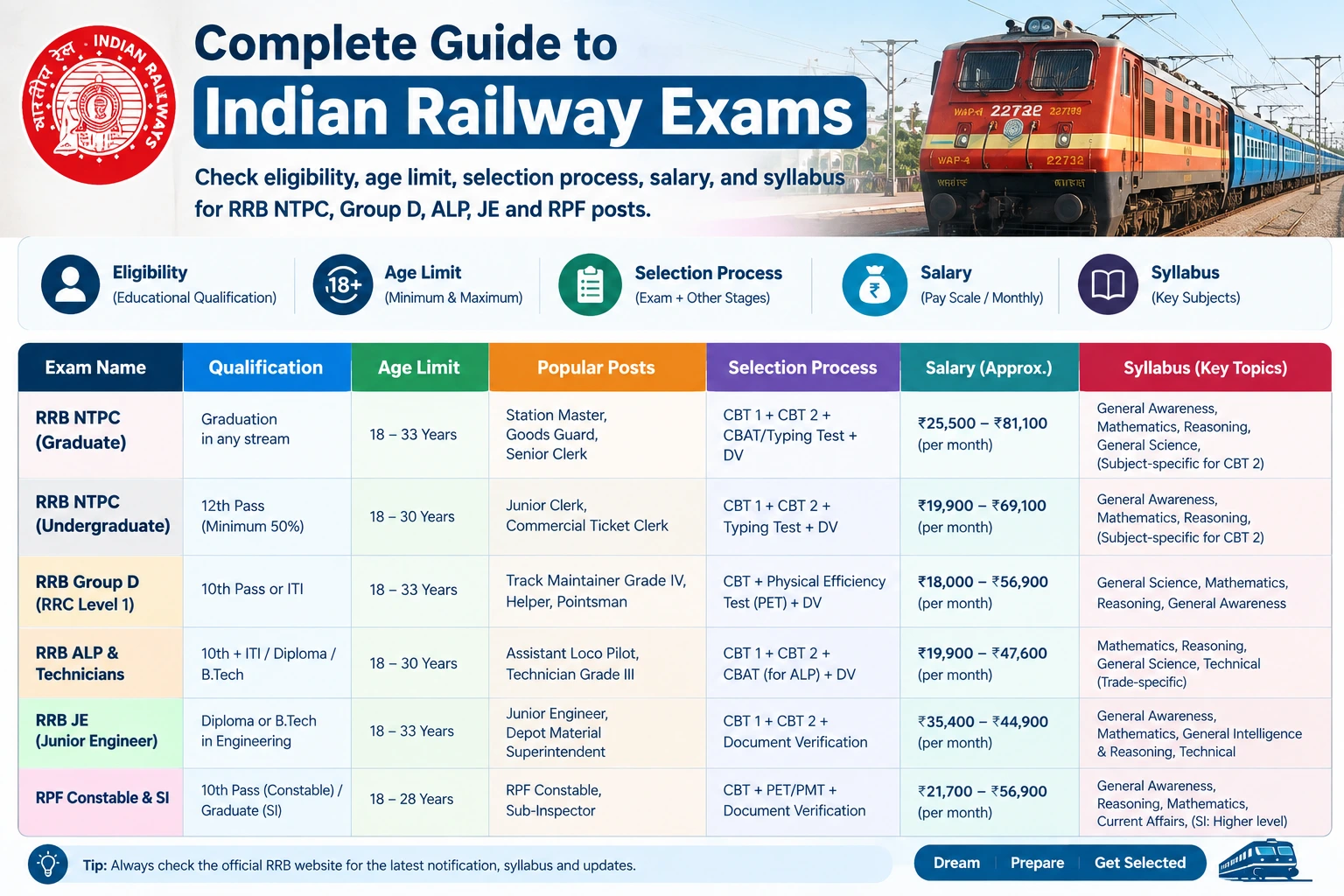
| Exam Name | Qualification | Age Limit | Popular Posts | Selection Process |
| RRB NTPC (Graduate) | Graduation in any stream | 18 – 33 Years | Station Master, Goods Guard, Senior Clerk | CBT 1 + CBT 2 + CBAT/Typing Test + DV |
| RRB NTPC (Undergraduate) | 12th Pass (Minimum 50%) | 18 – 30 Years | Junior Clerk, Commercial Ticket Clerk | CBT 1 + CBT 2 + Typing Test + DV |
| RRB Group D (RRC Level 1) | 10th Pass or ITI | 18 – 33 Years | Track Maintainer Grade IV, Helper, Pointsman | CBT + Physical Efficiency Test (PET) + DV |
| RRB ALP & Technicians | 10th + ITI / Diploma / B.Tech | 18 – 30 Years | Assistant Loco Pilot, Technician Grade III | CBT 1 + CBT 2 + CBAT (for ALP) + DV |
| RRB JE (Junior Engineer) | Diploma or B.Tech in Engineering | 18 – 33 Years | Junior Engineer, Depot Material Superintendent | CBT 1 + CBT 2 + Document Verification |
| RPF Constable & SI | 10th Pass (Constable) / Graduate (SI) | 18 – 28 Years | RPF Constable, Sub-Inspector | CBT + PET/PMT + Document Verification |
Standard Exam Pattern for RRB Exams
Most non-technical and technical exams conducted by RRB follow a uniform Computer-Based Test (CBT) structure divided into three primary sections:
- General Awareness & Current Affairs: 30–40 Questions
- Mathematics (Quantitative Aptitude): 25–30 Questions
- General Intelligence & Reasoning: 25–30 Questions
- General Science (Physics, Chemistry, Life Sciences up to 10th standard): 20–30 Questions
Negative Marking: Standard RRB exams apply a negative marking penalty of 1/3rd mark for every incorrect answer in the CBT stages.
Step-by-Step Selection Process
- Online Application Submission: Apply on official regional RRB websites (e.g., RRB Chandigarh, RRB Patna, RRB Mumbai).
- CBT Stage 1 (Screening Test): Qualifying round used to shortlist candidates for Stage 2.
- CBT Stage 2 (Mains Exam): Scores in this stage directly determine final merit allocation.
- Skill Test / Physical Test:
- Computer Based Aptitude Test (CBAT) for Station Master & ALP.
- Typing Skill Test for Clerical posts.
- Physical Efficiency Test (PET) for RPF and Group D posts.
- Document Verification & Medical Examination: Strict physical fitness standards, especially visual acuity checks (A1 to C2 standards depending on the post).
How to Start Preparing for Railway Exams
- Master Core Mathematics: Focus on basic arithmetic, percentages, speed-distance-time, algebra, and geometry.
- Stay Updated with Current Affairs: Read daily news focusing on national events, sports, awards, and specifically Railway-related facts and achievements.
- Practice General Science: Clear basic concepts from Class 9 and 10 NCERT Science textbooks.
- Take Online Quizzes & Mock Tests: Improve speed and accuracy under time constraint conditions.